


Green Infrastructure (GI)
Rutgers.jpg)
What is Green Infrastructure?
Green Infrastructure treats and soaks up rainwater through filtration, infiltration, and evapotranspiration. Green infrastructure may also be referred to as nature-based solutions, green stormwater infrastructure, and, low-impact development.
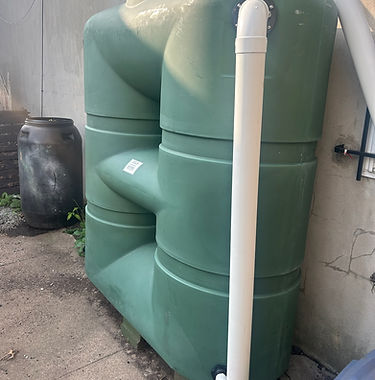
Cisterns/ Rain Barrels
Cisterns are stormwater management practices used to capture, collect and reuse stormwater runoff from clean roofs. Cisterns are generally larger systems. A rain barrel is usually smaller and meant to hold around 60 gallons connected to a single-family residential home. Larger buildings would use a series of rain barrels or a cistern. Cisterns are ideal for harvesting rainwater for non-potable uses, vehicle washing or toilet flushing. Cisterns are extremely versatile and may be used on a variety of sites ranging from smallscale residential sites to large-scale industrial or commercial sites; they may be placed either indoors or outdoors and above, at or below grade. They can also be used in various shapes and sizes. Cisterns must be designed based upon on-site water needs; an under-sized cistern may not store sufficient water for site demands. An over-sized cistern may remain full or near-full most of the time, and thus, be unable to provide storage during rain events. A cistern must have a maintenance plan and must be reflected in a deed notice recorded in the county clerk's office to prevent alteration or removal.
650-gallon cistern implemented on May 18th, 2015 at the Greater Newark Conservancy. Estimated stormwater captured and treated per year is 10,296 gallons.

Dry Well
A dry well is a subsurface storage facility, consisting of either a structural chamber or an excavated vault that is only used to collect and temporarily store stormwater runoff generated by a clean roof; treatment of runoff obtained from any other surface is prohibited. Outflow from a dry well is through infiltration into the subsoil, although they are required to have an overflow for diverting runoff generated by larger storms. Dry wells may be used to meet the groundwater recharge design standard at N.J.A.C. 7:8-5.4(b)(1). Additionally, dry wells may be used to reduce the stormwater runoff produced by the Water Quality Design Storm (WQDS) falling on a roof.
Dry well installation in Millburn Township in Essex County. Evaluation and Demonstration of Stormwater Dry Wells and Cisterns in Millburn Township, New Jersey (2014)

Grass Swale
A grass swale is a stable, parabolic or trapezoidal channel that is lined with turf; it is used to improve water quality and convey stormwater runoff. Grass swales do not rely on the permeability of the underlying soil for pollutant removal; instead, pollutants are removed by settling and filtration through the grass.
NEW JERSEY DEPARTMENT OF ENVIRONMENTAL PROTECTION· DIVISION OF WATER QUALITY

Green Roof
A Green Roof is a roof covered with a growing medium and vegetation. They are effective in reducing the amount of stormwater runoff leaving a site. It consists of vegetation planted in growing media on top of a drainage layer that intercepts stormwater runoff and reduces the total volume of runoff through evapotranspiration.
Green Roof at Rutgers University Newark Business School 2009

Rain Garden
A rain garden is a shallow 6"-8" deep basin planted with native plants that are adapted to our locale and specific weather patterns. It captures and detains rainwater and allows it to infiltrate the ground, usually within 24 hours. As the water passes through the plants' root zones, microorganisms filter and consume pollutants.
Andrea Adebowale Memorial Raingarden is on Central Avenue, Sussex Avenue, and MLK Blvd

Pervious Paving System
A pervious paving system is a stormwater management facility used to address the impacts of land development. The system consists of a durable, permeable surface course, which allows stormwater runoff to move through it; this surface course is placed over a transition layer and a storage bed of open-graded. There are two types: underdrained systems and systems designed to infiltrate into the subsoil.
Clark Townhall has pervious paving. The parking spots with porous asphalt pavement are "dry" while the rest of the lot has water accumulating at the surface.

Tree Filter Box/ Enhanced Tree Pit
A tree box is designed to collect the first flush of stormwater and treat it prior to discharge into the storm sewer system or to the subsoil. The structure is a pre-manufactured concrete box which is installed in-ground, filled with soil media and typically planted with native, non- invasive tree or shrub.
Tree Filter Box from Rutgers Water Resource.